
Voorbij de tegenstelling tussen oude en nieuwe osteopathie
Wat het huidige wetenschappelijke bewijs ons leert over Fryette, segmentale specificiteit en HVLA

Yourik van Overloop Joint-Principal, International Academy of Osteopathy (IAO) Formerly active in Anatomy & Neuroscience, Amsterdam UMC Grégoire Lason Founder & Joint-Principal, International Academy of Osteopathy (IAO)
Evidence-informed educational review | September 2026 Abstract Debate around spinal biomechanics in osteopathy is often framed as a choice between traditional models and newer technical approaches. This evidence-informed educational review examines current literature on coupled spinal motion, Fryette's principles, segmental palpation, target specificity, high-velocity low-amplitude (HVLA) manipulation, cavitation and proposed treatment mechanisms. A targeted, iterative literature search prioritised systematic reviews, meta-analyses and directly relevant primary studies available up to 21 September 2026. Current evidence does not support treating Fryette's principles as universal laws, but neither does it justify dismissing coupled spinal motion as obsolete. Clinical evidence does not demonstrate superior outcomes from exact vertebral targeting; notably, a 2025 network meta-analysis ranked general and nonspecific spinal manipulation highest for the probability of larger average effects, but on very-low- to low-certainty evidence. Measurable biomechanical effects of HVLA have been reported, yet their relationship to clinical outcomes remains uncertain. Bilateral cavitation should not be conflated with intentional bilateral manipulation, and comparative evidence does not establish routine bilateral manipulation as superior. For education, the appropriate response is not less precision but greater conceptual discipline: students should learn to distinguish clinical observations, model-based classifications, technical targets and established mechanisms while integrating safety, patient preference and critical appraisal.
Keywords: osteopathy; Fryette; coupled motion; spinal manipulation; HVLA; palpation; cavitation; segmental specificity
1. Introduction Questions about Fryette, segmental specificity and spinal manipulation are often framed as a choice between traditional osteopathy and modern evidence-based practice. That framing is too simple. Historical models can remain educationally useful without being treated as literal biological laws, while newer technical approaches do not become superior merely because they depart from older theory. This review is also informed by the first author's previous work in anatomy at Amsterdam UMC. That experience reinforces an important principle: biological systems are structured, but they are also variable. Vertebral morphology, facet orientation, joint geometry and surrounding tissues all influence movement. Anatomical reality therefore makes biomechanical models valuable for organising complexity while cautioning against treating any simplified model as a universal rule. The central question, therefore, is not whether osteopathic biomechanics should be preserved or abandoned. It is how anatomical precision, technical skill and scientific uncertainty can be taught together without overstating what the evidence can support. As Joint-Principals of IAO, we consider the same critical approach essential at an educational level. Osteopathic education should not merely transmit established models; it should teach students to examine those models, understand the evidence that supports them, recognise their limitations and remain willing to revise their interpretation as knowledge develops. Critical thinking is therefore not an addition to technical education. It is part of the educational responsibility of a Master of Science programme: students should learn not only how to perform a technique, but also how to distinguish observation from interpretation, evidence from assumption, and a useful model from an established biological fact.
2. Evidence base, search approach and scope This article is an evidence-informed educational review rather than a formal systematic review. It addresses specific educational questions concerning spinal coupled motion, Fryette mechanics, manual palpation, spinal manipulation specificity, cavitation and proposed mechanisms of HVLA. The purpose is to examine what the available research supports and where uncertainty remains; it is not to compare institutions, curricula or graduate outcomes.
The literature search was targeted and iterative rather than systematic. PubMed and journal or publisher sources were searched during September 2026 using combinations of terms relating to Fryette mechanics, coupled spinal motion, palpation reliability, spinal manipulation target specificity, HVLA biomechanical effects, cavitation or audible pop, manual therapy mechanisms, and unilateral or bilateral manipulation. Priority was given to systematic reviews and meta-analyses. Directly relevant primary studies were included when they addressed a central question not adequately resolved by higher-level evidence or when they were needed to interpret a frequently cited claim. The last targeted search was performed on 21 September 2026. No PRISMA-style exhaustive screening, protocol registration or independent certainty grading was undertaken for this article; certainty descriptions are taken from the source reviews where reported. Accordingly, this article should be read as an evidence-informed educational review, not as primary research, a systematic review or external validation of any curriculum.
Table 1. Evidence at a glance
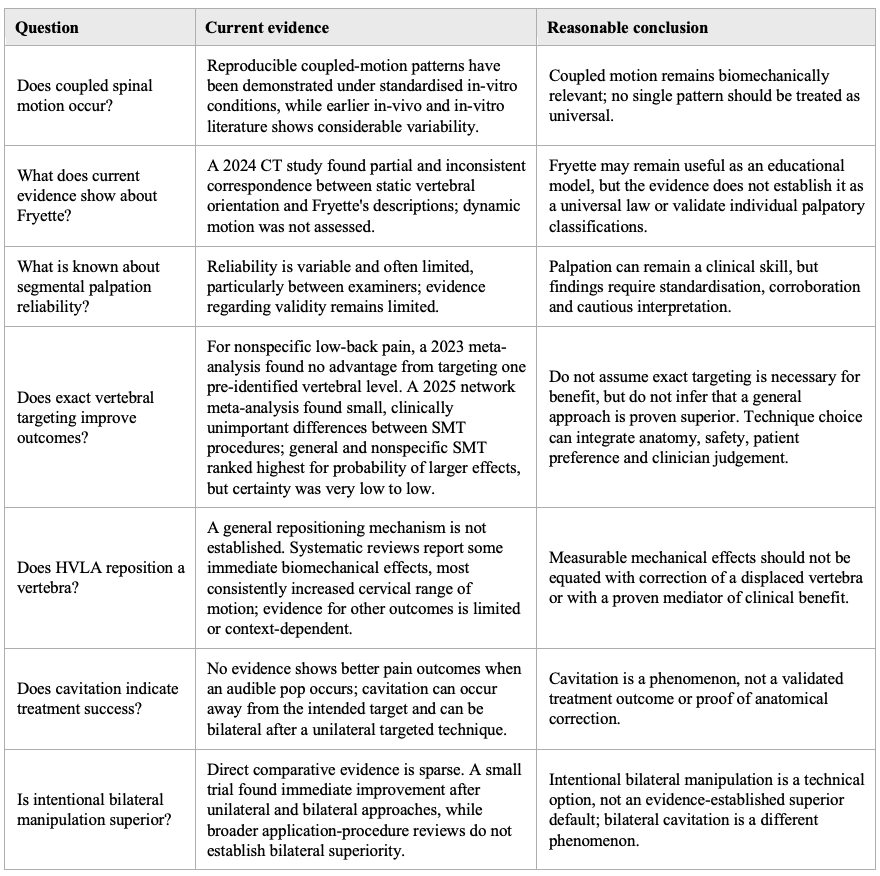
3. Coupled spinal motion remains biomechanically relevant A fundamental element of traditional spinal biomechanics is coupled motion: movement in one plane accompanied by movement in another. Contemporary biomechanical research does not support dismissing this phenomenon as obsolete.
A systematic review by Sizer, Brismée and Cook identified ipsilateral (same-side), contralateral (opposite-side) and mixed thoracic coupling patterns rather than one fixed relationship across all circumstances [1]. More recently, Liebsch and Wilke performed a systematic review and meta-analysis of standardised in-vitro studies and found reproducible relationships between lateral bending and axial rotation, with patterns differing by spinal region and primary movement direction [2]. The defensible conclusion is therefore not that coupled motion follows one universal rule, but that coupled motion is measurable and context dependent.
4. What does current research show about Fryette? Fryette's principles have historically provided osteopathic students with a structured framework for describing three-dimensional vertebral motion. The question is not whether the model is old, but how accurately it represents observed spinal behaviour. Haughton and colleagues used three-dimensional CT-derived orientation data to examine thoracic and lumbar vertebrae. Of 531 analysed vertebrae, 56.9% demonstrated static positions compatible with Fryette's mechanics [3]. The authors concluded that static vertebral positions may align with Fryette's descriptions, but that this correspondence was inconsistent, and they called for further investigation of dynamic spinal behaviour. This study should therefore not be presented as “validation of Fryette”. Equally, it does not support the assertion that Fryette has no relationship to observable vertebral behaviour. The most proportionate interpretation is that Fryette describes recognisable patterns that may remain educationally useful, but should not be taught as universal laws. These evidence streams should not be conflated with the clinical reliability of a palpatory classification. Demonstrating coupled motion under experimental conditions, or observing partial static correspondence with Fryette in CT datasets, does not establish that an ERS, FRS or NSR classification assigned to an individual patient is reliable, valid or clinically decisive. Those are separate questions that require a different evidence base.
5. An anatomical perspective: structure does not equal rigidity Human anatomy is remarkably consistent in its general organisation, yet variation is present at virtually every level. Left-right asymmetry in facet orientation, commonly described as facet tropism, is documented in both lumbar and cervical regions [18]. The kinematic literature likewise shows that coupled movement differs by region, level and loading direction [1,2]. In anatomy and biomechanics, "it depends" can be the most scientifically accurate answer rather than an evasive one. It depends on the region, individual anatomy, the starting position, the applied load, the surrounding tissues and the specific question being asked. Context does not make biomechanics arbitrary; it makes biomechanics biological. From an anatomical perspective, it would therefore be biologically unexpected for every vertebral segment to follow one identical coupled-motion rule under all conditions. This does not diminish the value of biomechanical models. On the contrary, models are essential for teaching because they provide structure to biological complexity. The important distinction is that a model should help us understand anatomy rather than replace anatomical reality. This provides a useful way to interpret Fryette today: as a framework that helps students conceptualise and communicate three-dimensional spinal motion, while recognising that individual anatomy and loading conditions can produce movement outside the simplified pattern.
6. A clinical movement finding is not the same as a structural lesion Terminology matters because it shapes how students and patients understand clinical findings. The historical term 'osteopathic lesion' can imply structural pathology or tissue damage, whereas classifications such as extension-rotation-sidebending (ERS), flexion-rotation-sidebending (FRS) and neutral-sidebending-rotation (NSR) are model-based descriptions derived from clinical movement assessment. The concept of somatic dysfunction is widely used in contemporary osteopathic research. A scoping review including 280 studies found substantial variation in definitions and assessment approaches [4]. The authors proposed considering somatic dysfunction as a clinical value that can assist assessment and decision-making. This supports cautious use of the concept as a clinical finding rather than as proof of one specific structural pathology. Accordingly, language such as 'segmental dysfunction' or 'segmental movement dysfunction' is more compatible with the distinction between a clinical finding and a demonstrated lesion. For example, 'T6 ERSr' means that T6 has been classified within a Fryette-based model as relatively extended with rotation and sidebending to the right during the examination. It does not mean that imaging has demonstrated a displaced vertebra or structural tissue damage.
7. Specificity should not be confused with certainty Questioning the biological certainty of a palpatory finding does not require abandoning anatomical or technical specificity. Students still need to identify vertebral levels, understand facet orientation, assess movement, establish precise contacts and control force vectors. However, systematic reviews have shown important limitations in the reliability of manual palpation, while evidence regarding validity remains limited. Nolet and colleagues reported generally poor reliability for palpation of bony structures and joint mobility and found that validity had been investigated only sparsely [5]. An osteopathy-specific systematic review similarly found heterogeneous diagnostic reliability and generally better intra-examiner than inter-examiner agreement [6]. The educational response should therefore be standardisation rather than vagueness: clear landmarks, consistent procedures, calibrated examiner expectations and explicit recognition that manual findings are clinical data with measurement error.
8. Does clinical benefit depend on targeting one exact vertebral level? A 2023 systematic review and meta-analysis evaluated 10 randomised controlled trials involving 931 people with nonspecific low-back pain. Targeting manipulation to a specifically identified vertebral level did not result in superior pain or disability outcomes compared with non-targeted manipulation [7]. A broader 2025 systematic review and network meta-analysis of 161 randomised controlled trials involving 11,849 participants examined whether outcomes varied according to spinal manipulation application procedures, including target, thrust and treated region. Differences between spinal manipulative therapy procedures were small and not clinically relevant. A general and nonspecific approach had the highest probability of achieving the largest average effects. However, the authors rated the evidence as very low to low certainty, principally because of substantial heterogeneity, risk of bias and a lack of direct comparisons [8]. These findings do not show that 'it does not matter where or how a clinician manipulates', nor does the ranking prove that a general or nonspecific strategy is superior. They show something more limited: current clinical evidence does not demonstrate that superior outcomes depend on correcting one exact pre-identified vertebral articulation. The authors of the 2025 review concluded, with low-certainty evidence, that SMT could reasonably be applied in accordance with clinician preferences and patient preferences and comfort [8]. Technical targeting can therefore remain an educational competency without being presented as a proven prerequisite for clinical effectiveness. Importantly, recognition of biological variability should not lead to less precise manual therapy. From an anatomical perspective, the opposite is more appropriate: detailed knowledge of vertebral morphology, facet orientation, disc geometry and surrounding tissues allows the practitioner to position the patient and apply force with greater control. Scientific uncertainty about the exact mechanism of treatment should not be confused with technical imprecision.
9. Does HVLA put a vertebra back into place? The traditional explanation of spinal manipulation has sometimes implied that a vertebra is in an incorrect position and is returned towards a correct position by the thrust, meaning the brief, rapid and controlled impulse used in an HVLA technique. Current evidence does not support vertebral repositioning as an established general mechanism. A 2024 systematic review specifically examined immediate anatomical, structural and positional changes following manually delivered HVLA. The credible evidence identified transient changes in lumbar facet-joint spacing under specific post-manipulation positioning conditions; increased separation between the zygapophyseal joint surfaces is often referred to as facet-joint gapping. An immediate reduction in spinal stiffness was identified in one credible study. The studies directly examining vertebral position were rated non-credible by the reviewers [9]. A 2025 systematic review of 33 studies found its clearest biomechanical signal in cervical range of motion (ROM, the measurable extent of movement): cervical ROM tended to increase after cervical or thoracic HVLA thrusts. Effects on local thoracic and lumbar ROM, facet-joint gapping and spinal stiffness were less conclusive because studies were few or heterogeneous. Only one included study examined the relationship between a measured biomechanical effect and clinical outcomes [10]. The appropriate conclusion is therefore not that HVLA has no biomechanical effect. Rather, a biomechanical effect should not automatically be interpreted as anatomical correction of a misplaced vertebra.
10. Mechanisms of manual therapy are likely multifactorial It would be equally premature to replace a simple mechanical explanation with a simple neurophysiological one. A 2025 living review synthesised 62 reviews of mechanisms associated with manual therapy. The literature described peripheral, segmental spinal, supraspinal, neurovascular, neurological and neurochemical responses, while emphasising that the clinical relevance of many observed mechanisms remains uncertain [11]. A 2026 systematic review and meta-analysis of 50 studies and 2,147 participants likewise found short-term biological and neurophysiological responses to manual therapy, with evidence certainty generally ranging from low to moderate [12]. The most defensible formulation is that HVLA can generate measurable biomechanical and neurophysiological responses, while their relative contribution to clinical outcomes remains incompletely established.
11. Cavitation is a phenomenon, not a validated treatment outcome Audible cavitation, the joint event commonly perceived as a 'pop' during manipulation, is common during HVLA, but the sound itself should not be used as proof that a treatment has succeeded. A 2022 systematic review found no evidence that the presence of an audible pop was associated with superior pain outcomes following spinal manipulation [13]. Ross and colleagues also showed that cavitation during thoracic and lumbar manipulation did not consistently occur at the intended target [14]. During targeted upper cervical manipulation, Dunning and colleagues reported bilateral cavitation in 91.9% of manipulations despite unilateral targeting [15]. Together, these studies support a clear distinction between the clinician's technical intention and the exact articulation that cavitates. Cavitation may occur, but it does not validate a specific correction mechanism.
12. Is bilateral manipulation more evidence-based? Current evidence does not establish routine bilateral manipulation as clinically superior to unilateral or segmentally targeted approaches. For clarity, 'bilateral manipulation' in this article refers to an intentional treatment strategy in which manipulative procedures are applied to both sides. It should not be confused with bilateral cavitation, meaning sounds detected on both sides during a single targeted manipulation. The latter is an observation about where cavitation occurs, not evidence that two separate manipulations are required or superior. Direct comparative research is sparse. Clements, Gibbons and McLaughlin randomised 40 asymptomatic participants with a persistent unilateral passive atlanto-axial rotation asymmetry of at least 8 degrees to unilateral manipulation towards the restricted direction (n=14), unilateral manipulation away from the restricted direction (n=14), or bilateral manipulation (n=12). All three groups showed a statistically significant immediate reduction in rotation asymmetry, and the result occurred regardless of direction or bilateral application [16]. Because the study was small, involved asymptomatic participants and measured an immediate movement outcome rather than patient-centred clinical outcomes, it cannot establish equivalence or resolve whether one strategy is clinically preferable. More importantly, the broader systematic-review literature on manipulation application procedures does not show that one targeting strategy consistently produces superior clinical outcomes [8]. The scientifically appropriate conclusion is therefore not that bilateral manipulation is ineffective, nor that unilateral targeting is necessary, but that routine bilateral superiority has not been demonstrated. Bilateral and unilateral techniques can both be considered technical options. A limitation of one model is not, by itself, evidence that another model is superior.
13. Implications for contemporary osteopathic education The evidence does not support a simplistic choice between “old” and “new” osteopathy. It supports a more demanding educational approach in which students learn both structured biomechanical models and the limitations of those models. Contemporary osteopathic education can reasonably continue to teach detailed anatomy, coupled motion, segmental assessment, ERS/FRS/NSR classification, specific manual contacts and controlled HVLA technique. At the same time, students should learn that a classification is not identical to a structural diagnosis, that exact target specificity has not been shown to determine clinical outcome, and that no single mechanism currently explains the effects of spinal manipulation. Technique education should also remain subordinate to clinical reasoning and patient safety. Before deciding how to manipulate, a student should be able to justify whether manipulation is indicated at all, consider contraindications and relevant risk, obtain informed consent, take account of patient comfort and preferences, and recognise when a non-thrust, non-manual or referral option is more appropriate. The educational question is therefore broader than 'which manipulation should be used?' [8,17]. This approach is also consistent with the 2024 QAA Subject Benchmark Statement for Osteopathy, which expects graduates to integrate anatomical and biomechanical knowledge, clinical skills, research evidence and critical appraisal [17]. Taken together, the literature supports a set of educational principles that are useful beyond any single school or technique tradition. Fryette can organise learning without being treated as an immutable law. Technical precision and scientific humility can coexist: exact anatomy, contact and positioning can remain high-level competencies even when the biological meaning of a palpatory finding is uncertain. Likewise, treatment mechanisms should be described proportionately; HVLA has measurable biomechanical and neurophysiological effects, but no single mechanism has been established as the mediator of clinical benefit. Finally, the absence of evidence for one doctrine should not be used as evidence for a competing doctrine. Limitations of segmental correction models do not establish routine bilateral manipulation as superior.
14. From evidence to teaching: implications for IAO At IAO, these findings inform an ongoing review of how spinal biomechanics and HVLA are taught. They should not be read as a statement that every lecture, textbook, digital resource or assessment has already been revised. The objective is to align the interpretation of biomechanical models with contemporary research while preserving anatomical and technical precision. Implementation therefore requires deliberate alignment across teaching, learning materials, faculty expectations and assessment. As Joint-Principals of IAO, we consider this critical approach part of the institution's educational responsibility. Students should be able to use structured models without confusing them with biological facts, perform techniques with high anatomical and technical precision, justify their decisions in relation to safety and patient context, and describe uncertainty proportionately to the evidence.
Table 2. Translating the evidence into educational practice at IAO
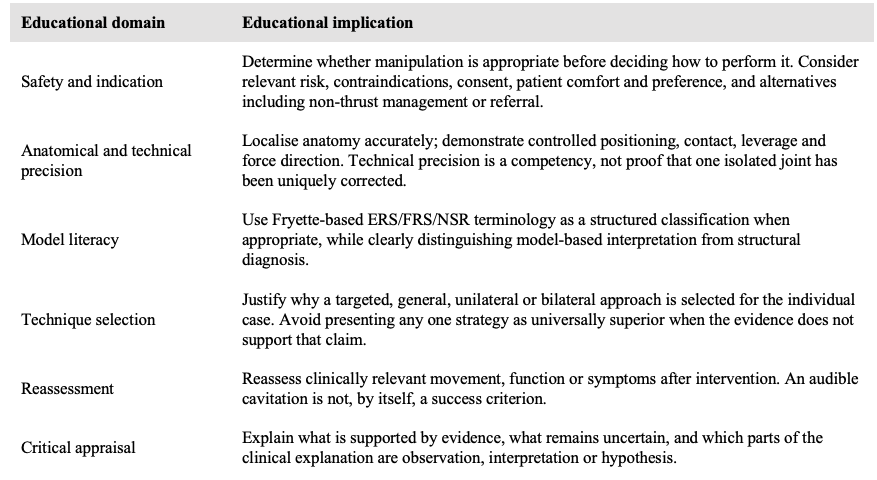
For this framework to have educational value, the same distinctions must be reflected consistently across classroom teaching, practical instruction, books and digital materials, examiner guidance and assessment criteria. This paper does not itself alter existing assessment rules; any curricular change should be implemented deliberately, communicated clearly and supported by faculty development.
15. Conclusion Current evidence supports neither the uncritical acceptance nor the wholesale rejection of traditional spinal biomechanical models. Coupled spinal motion has been demonstrated, but patterns vary according to region, movement direction, loading and experimental conditions. Fryette provides a framework that corresponds with some observed patterns, but should not be treated as a universal law or as validation of an individual palpatory diagnosis. Manual palpation remains a clinical skill with recognised limitations in reliability and limited evidence regarding validity. Exact vertebral targeting has not been shown to produce superior clinical outcomes, while the ranking of general and nonspecific SMT in a recent network meta-analysis is itself based on very-low- to low-certainty evidence. HVLA produces measurable biomechanical and neurophysiological responses, but a general vertebral repositioning mechanism is not established and the relationship between measured biomechanical changes and patient outcomes remains insufficiently understood. Cavitation is not a validated marker of treatment success, and current comparative evidence does not establish routine bilateral manipulation as superior. The educational implication is therefore not to choose between 'old' and 'new' osteopathy as competing doctrines. It is to teach students to use models precisely, test them critically, distinguish technical intention from biological certainty, and remain proportionate in what they claim. Anatomical precision, patient-centred safety and scientific humility are not competing values; in contemporary osteopathic education, they should develop together.
Glossary of key terms The definitions below are included to make the article accessible beyond readers already familiar with osteopathic technical terminology. They describe how terms are used in this article and should not be interpreted as independent diagnostic claims.
Table 3. Glossary
References
- Sizer PS Jr, Brismée JM, Cook C. Coupling behavior of the thoracic spine: a systematic review of the literature. J Manipulative Physiol Ther. 2007;30(5):390-399. https://doi.org/10.1016/j.jmpt.2007.04.009
- Liebsch C, Wilke HJ. Coupled motions of the spine under standardized in vitro conditions: a systematic review and meta-analysis. Front Bioeng Biotechnol. 2025;13:1686524. https://doi.org/10.3389/fbioe.2025.1686524
- Haughton DR, Barr EC, Gupta AK, Toohey WC, Kania AM. Investigating Fryette's mechanics in computed tomography scans: an analysis of vertebrae spinal physiology using open-sourced datasets and three-dimensional vertebral orientation. J Osteopath Med. 2024;124(10):429-435. https://doi.org/10.1515/jom-2023-0088
- Tramontano M, Tamburella F, Dal Farra F, et al. International Overview of Somatic Dysfunction Assessment and Treatment in Osteopathic Research: A Scoping Review. Healthcare. 2022;10(1):28. https://doi.org/10.3390/healthcare10010028
- Nolet PS, Yu H, Côté P, et al. Reliability and validity of manual palpation for the assessment of patients with low back pain: a systematic and critical review. Chiropr Man Therap. 2021;29:33. https://doi.org/10.1186/s12998-021-00384-3
- Basile F, Scionti R, Petracca M. Diagnostic reliability of osteopathic tests: A systematic review. Int J Osteopath Med. 2017;25:21-29. https://doi.org/10.1016/j.ijosm.2017.03.004
- Sørensen PW, Nim CG, Poulsen E, Juhl CB. Spinal Manipulative Therapy for Nonspecific Low Back Pain: Does Targeting a Specific Vertebral Level Make a Difference? A Systematic Review With Meta-analysis. J Orthop Sports Phys Ther. 2023;53(9):529-539. https://doi.org/10.2519/jospt.2023.11962
- Nim C, Aspinall SL, Cook CE, et al. The Effectiveness of Spinal Manipulative Therapy in Treating Spinal Pain Does Not Depend on the Application Procedures: A Systematic Review and Network Meta-analysis. J Orthop Sports Phys Ther. 2025;55(2):109-122. https://doi.org/10.2519/jospt.2025.12707
- Young KJ, Leboeuf-Yde C, Gorrell L, et al. Mechanisms of manipulation: a systematic review of the literature on immediate anatomical structural or positional changes in response to manually delivered high-velocity, low-amplitude spinal manipulation. Chiropr Man Therap. 2024;32:28. https://doi.org/10.1186/s12998-024-00549-w
- Langenfeld A, Baechler M, Swanenburg J, et al. Systematic review on biomechanical effects of high-velocity, low amplitude spinal manipulation. PLoS One. 2025;20(7):e0328048. https://doi.org/10.1371/journal.pone.0328048
- Keter DL, Bialosky JE, Brochetti K, et al. The mechanisms of manual therapy: A living review of systematic, narrative, and scoping reviews. PLoS One. 2025;20(3):e0319586. https://doi.org/10.1371/journal.pone.0319586
- Villani G, Rahmaniharedasht R, Cinti F, et al. Biological effects of technique-specific manual therapy in healthy individuals and people with musculoskeletal disorders: a systematic review with meta-analysis. J Man Manip Ther. Published online September 5, 2026. https://doi.org/10.1080/10669817.2026.2725751
- Moorman AC, Newell D. Impact of audible pops associated with spinal manipulation on perceived pain: a systematic review. Chiropr Man Therap. 2022;30:42. https://doi.org/10.1186/s12998-022-00454-0
- Ross JK, Bereznick DE, McGill SM. Determining cavitation location during lumbar and thoracic spinal manipulation: is spinal manipulation accurate and specific? Spine. 2004;29(13):1452-1457. https://doi.org/10.1097/01.BRS.0000129024.95630.57
- Dunning J, Mourad F, Barbero M, Leoni D, Cescon C, Butts R. Bilateral and multiple cavitation sounds during upper cervical thrust manipulation. BMC Musculoskelet Disord. 2013;14:24. https://doi.org/10.1186/1471-2474-14-24
- Clements B, Gibbons P, McLaughlin P. The amelioration of atlanto-axial rotation asymmetry using high velocity low amplitude manipulation: Is the direction of thrust important? Journal of Osteopathic Medicine. 2001;4(1):8-14. https://doi.org/10.1016/S1443-8461(01)80038-1
- Quality Assurance Agency for Higher Education. Subject Benchmark Statement: Osteopathy. 2024.
- Garg K, Aggarwal A. Facet Tropism in Lumbar Spine and Cervical Spine: A Systematic Review and Meta-Analysis. World Neurosurg. 2021;147:47-65. https://doi.org/10.1016/j.wneu.2020.11.171